


Synthetic data needs experimentation to flourish
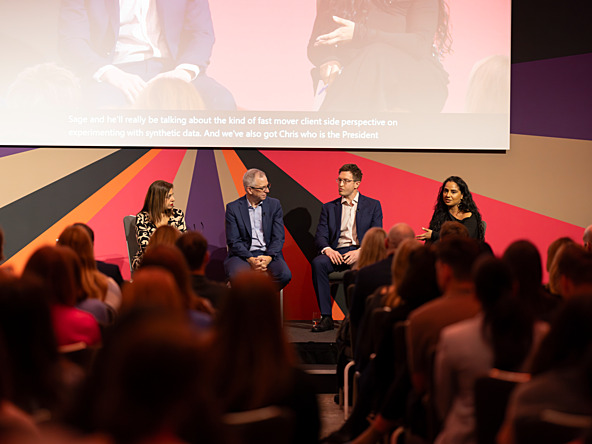
Speaking on a panel about synthetic data, Chris Barnes, president at Escalent, said experimentation was the key to unlocking the technology’s potential.
“If you are not running experiments, and you are waiting for someone to bring you a fully formed solution, you are making a massive mistake,” he said.
“It is hard to get budget to run an experiment, to tell your stakeholder ‘hey, this might not work’, but you need to do it because there are some fundamental questions you need to answer.”
There also needs to be a proper examination of what data is needed to underpin synthetic data models, Barnes added, and whether existing statistics within an organisation are robust enough to feed into personas, for example.
“If you think boosting or the creation of personas allows you to use the same statistics you’ve always been using, and focus on things like sampling error, you’re wrong,” said Barnes.
“If you don’t know the fundamental statistics your organisation is going to trust, and have this focus on increasing the probability of being right when you tell your stakeholders, rather than sampling error or how many people were asked, you’re going to make a mistake.”
Barnes said that research would become more “kinetic”, with stakeholders increasingly focused on outcomes, such as sales impacts, making experiments with synthetic data vital to make sure that the models are competent enough to achieve real-life results.
Robin Queripel, global senior insights manager at Sage, told the panel that at Sage, the insights team had taken ownership of the use of AI and synthetic data, with the technology being used alongside the work of human researchers.
“Critical to all of this is the human component,” he explained. “We are not just accepting the results that come out – insight professionals are reviewing, we are learning.”
Queripel said that insight professionals needed to embrace synthetic data. “The reality is synthetic is here, and whether you are adopting it or not adopting it, whether you are working with it or not working with it, it is part of the insight world.
“For us, it is about embracing it and seeing how it can help us, and that’s what we will continue to do into the future: experimentation.”
There are limitations to the technology, Queripel added, which need to be understood. “The key thing for me that you don’t get from the AI is the emotional element,” he suggested. “A lot of what we do is bringing to life the emotion of our audiences – who they are as real people, what are their struggles. You don’t always pick that up through using AI.”
He concluded: “You still need the people, you still need the insight professionals, because it is critical to have a human lens on everything we do. The AI is there to support or enable us scale up, but that human companion is key.”
Risham Nadeem, innovation director at C Space, said in the session that “organic chatter” should be highly valued, and should be a form of research undertaken by humans, rather than AI.
She said: “I have a very strong view that exploratory research of any kind, foresight research, anything that is future facing and where you want to be capturing emerging trends, I don’t know that with the state of synthetic as it is at the moment that that’s something I would be comfortable with outsourcing.”
However, Nadeem added that she would recommend synthetic data for research with niche business-to-business audiences, adding that “there are only going to be so many CFOs on panels”.

We hope you enjoyed this article.
Research Live is published by MRS.
The Market Research Society (MRS) exists to promote and protect the research sector, showcasing how research delivers impact for businesses and government.
Members of MRS enjoy many benefits including tailoured policy guidance, discounts on training and conferences, and access to member-only content.
For example, there's an archive of winning case studies from over a decade of MRS Awards.
Find out more about the benefits of joining MRS here.







0 Comments