


Foresight ‘about connecting businesses to a future state’
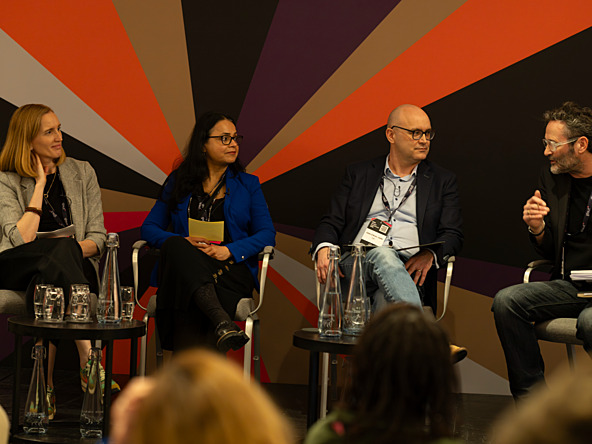
Speaking on the panel, Dr Shane Hanson, director of strategy, marketing, shopper and user insight at Panasonic, said storytelling was a key skill to help make the case for foresight within organisation.
“Foresight struggles sometimes because the day-to-day, the current, the here-and-now gets funding,” Hanson said.
“One of the big challenges from a foresight perspective is how to manage stakeholders. The skill of storytelling is more important than ever before in order to bring the stakeholders together with you on the journey.”
Hanson gave the examples of how foresight made the case for innovation in the large television category, one that Panasonic had felt was in decline given the rise in solo viewing and smaller screens, with research suggesting there was a demand for shared viewing experiences.
“The foresight piece of work is about not only giving reassurance about future trends or innovation roadmaps, but connecting the current business to a future state,” Hanson said, adding that in consumer electronics, innovation cycles can take seven to eight years, and therefore provide an opportunity for foresight to support product development.
In addition, Hanson made the case for insight teams to own foresight, noting the close relationships the discipline had with marketing within many organisations, adding: “We have built that trust, and when foresight is needed, they trust us to do the right job.”
Also speaking on the panel, Eddie O’Brien, senior director, global customer insight at Sage, said that foresight struggles because of how performance is measured in an organisation, such as through sales or revenue generated.
“When you are talking about stuff that is three to five years in the future and horizon scanning, the challenge is that it’s not that people don’t understand it, it’s that the system is not designed for it,” O’Brien said.
“Anything that is not contributing to the near term is a distraction – that’s the reality.”
He added that foresight gets pushed aside not because it lacks value, but because it can “get in the way” of a focus on short-term priorities. O’Brien made the case for foresight being something that “lives and breathes in the here and now”, noting that in a volatile market and world, the future is already happening.
O’Brien also warned about the impact of AI and said that foresight was a way for the industry to adapt to automation of work elsewhere.
“Fundamentally, what is happening is our business model in our industry is being questioned,” he said. “For me, this is an example of where our industry can come to the fore – foresight has its opportunity. As insight professionals, we can look out for the signals, the attitudes and the behaviour change.”
Edith Bardin, global brand and strategic comms insight adviser at Shell, said that there was an argument for placing foresight within companies’ strategy functions, helping to focus on scenario planning and having the power to help shape company direction.
“When we think about foresight, sometimes it might sit better in a non-insight function,” Bardin added.

We hope you enjoyed this article.
Research Live is published by MRS.
The Market Research Society (MRS) exists to promote and protect the research sector, showcasing how research delivers impact for businesses and government.
Members of MRS enjoy many benefits including tailoured policy guidance, discounts on training and conferences, and access to member-only content.
For example, there's an archive of winning case studies from over a decade of MRS Awards.
Find out more about the benefits of joining MRS here.





0 Comments