


The world is on fire. Are you OK?
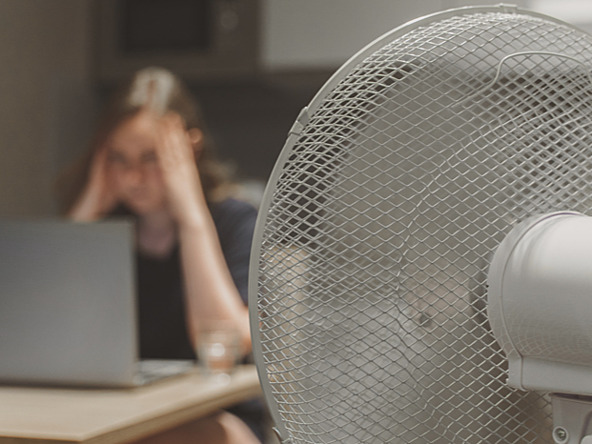
I don’t think I’ve started a work call in the past three weeks without weather chat. We all know it’s hot, regardless of where we are. How is everyone coping? How are their kids managing? How do they feel about it all?
We’ve discussed how cool people’s homes and offices stay, their personal cooling solutions, the merits of air conditioning, school closures, sleep disruption and general fatigue.
I invariably acknowledge that we’re doing that very British thing of ‘weather chat’ as a form of small talk to ease us into conversations. My schtick is weather chat and wryly acknowledging we’re doing more of it than usual. I’m tired of the heat, and I’m tired of my schtick.
I think we have to recognise at this point that how people might be feeling, and what they might be prepared to talk about, could cut deeper than a superficial sheen of sweat and the juggle of life admin in 30-plus degrees.
The Guardian has just reported that it is estimated that the June heatwave killed 440 people a day in England and Wales. This is compared to roughly four road deaths and 35 alcohol- or drug-related deaths a day1.
Over the weekend, various wildfires broke out, including one in Spain that has killed at least 13 people. More people remain unaccounted for. There have been several in the UK, including a large one in North Wales. A major wildfire has just broken out in the Fontainebleau forest near Paris, which is where one of our Lovebrands team lives. Fortunately, she’s OK.
But of course, being safe from wildfires doesn’t mean we’re alright.
One of the most widely reported studies on eco-anxiety is a 10-country study on young people aged 16-25, from 2021. Respondents across all countries were worried about climate change ( 59% were very or extremely worried and 84% were at least moderately worried). Many of us will have people that age bracket in our workplaces, or in our families3.
There are various other studies and papers focussing on young people’s feelings about climate change, but less so for those aged 25-plus, as if we are less affected. Yet, clearly, we’re not immune to feelings of alarm and grief. In its paper ‘Climate change impacts on mental health in the UK’, the Imperial Grantham Institute notes that in the UK, 60% of the public indicate that awareness of climate change affects their mental health4.
Lise Van Susteren, a psychiatrist specialising in the psychological effects of climate change, sees eco-anxiety as a form of ‘pre-traumatic stress disorder’, a term she has coined5. Climate anxiety is becoming more and more of a significant concern in therapy. In Germany, 72% of psychotherapists reported having had patients expressing concerns about climate change during treatment6.
Locally to me, a climate-aware therapist who lectures at the University of Bath, Caroline Hickman, has seen referrals quadruple in the past five years7. My own therapist, also Bath-based, backs this up – she told me she’s seen a notable increase in people talking about climate anxiety. But not just this – a general sense of fragility and instability in the world. A recognition of polycrisis. More and more, she said, people increasingly want to work on issues outside of their own small spheres of work and family.
There are times when I feel like we need to be allowed to pause and acknowledge that it’s hard to blunder on through our day jobs without talking about this stuff. So far with the summer heatwaves, there hasn’t necessarily been a collectively traumatic event where you live or I live. Instead, it’s the accumulation of fatigue from sleeping less well, plodding through work in sub-optimal conditions, carrying the strain of managing heat-sensitive kids or making it to a meeting on time, but through a lot of travel disruption and on a train without air-conditioning. And it’s the seeping in of anxiety and grief as yet more alarming news stories break on the impacts of the heat across Europe.
It is important that employers open up dialogue with their teams on how they are finding this heatwave physically and emotionally. Consider whether workloads are sustainable at this point in time, given how people are feeling. Ask if people need any equipment and accommodations to work effectively.
For employers with the means to go further, it’s worth checking if your healthcare policy and any other mental health solutions you have in place are suited to support people in dealing with the complexity of anxieties they may be dealing with in today’s volatile world.
Lastly, consider whether you’re still putting the attention to your sustainability policy that you did when we had the first flurry of engagement in climate change in this sector about five years ago. Employees just might start questioning this, if they haven’t already. There is a red thread between how we support staff navigating this heatwave, the work we choose to do, and how we choose to run our businesses.
Louise McLaren is managing director (London) at Lovebrands and a columnist for Research Live
References
1: https://www.theguardian.com/environment/2026/jul/13/june-heatwave-killed-440-people-a-day-england-wales-data-suggests-climate-crisis
2: https://news.sky.com/story/british-woman-becomes-13th-person-to-die-after-wildfire-in-spain-officials-say-13562889
3: https://www.thelancet.com/journals/lanplh/article/PIIS2542-5196( 21 )00278-3/fulltext
5: https://globalhealthnow.org/2017-03/climate-change-and-mental-health-qa-lise-van-susteren-md

We hope you enjoyed this article.
Research Live is published by MRS.
The Market Research Society (MRS) exists to promote and protect the research sector, showcasing how research delivers impact for businesses and government.
Members of MRS enjoy many benefits including tailoured policy guidance, discounts on training and conferences, and access to member-only content.
For example, there's an archive of winning case studies from over a decade of MRS Awards.
Find out more about the benefits of joining MRS here.









0 Comments