


Combatting misinformation a ‘fight between truth and lies', event hears
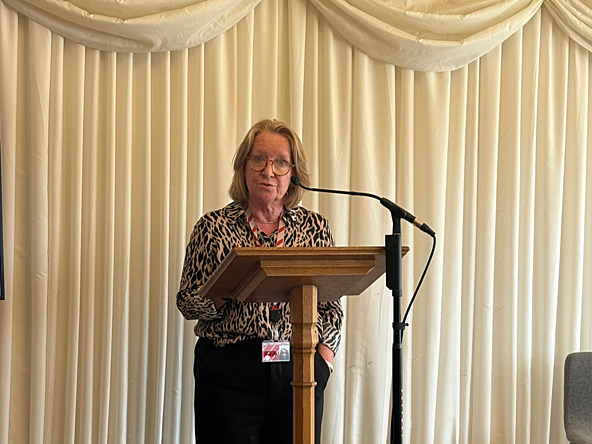
The recent local elections highlighted the issues around access to reputable information within UK society at the moment, according to Deborah Mattinson, member of the House of Lords and president of the Market Research Society (pictured), speaking at the event at the Palace of Westminster on Tuesday 9th June.
“It is not about left or right – it is about truth,” she said. “It is about the bombarding of voters that has happened in the last few weeks with misinformation on a scale that we have genuinely never seen before. It is terrifying.”
She added: “Fighting misinformation is the fight between truth and lies – we should be very straightforward about that, because misinformation is quite a polite way of putting it.”
Mattinson argued that recent generations “have been in the habit of taking our democracy for granted”, adding that “we presumed everyone had a shared interest in truth rather than lies, and we presumed we could trust the data we were given”.
Instead, social media has become the main source of news for many people, which has accelerated problems with the veracity of information people are consuming.
Social sciences are key for insights, Mattinson added. “Understanding our history really matters,” she explained. “As IJMR itself has highlighted, a historical perspective allows us to better understand the present and avoid reinventing the wheel, while equipping us to anticipate the future.
“We have never needed to draw on that more than we do today. Underpinning everything we do is our conviction that evidence matters – that means truth matters, and truth matters now more than ever, because it faces a real jeopardy that I don’t think it has faced before.”
Chris Curtis, Labour MP for Milton Keynes North, hosted a panel at the event and said that there had been an uptick in misinformation and disinformation recently.
“Conspiracy theories have always been out there, but the extent to which a normal people who moderately engage in politics suddenly believe things very strongly that aren’t true, there seems to be an increasing number of examples of that happening,” Curtis said.
“We are also seeing bad faith actors from abroad and domestically trying to use that to undermine our politics and our democracy.”
Jane Green, professor at Nuffield College at the University of Oxford and member of the leadership team for the British Election Study, told the panel that local media ‘deserts’ were boosting misinformation, adding that “it is the decline of traditional media that is creating that audience and demand” for other sources of information about politics.
She added that UK was seeing the rise of the first political party reliant on social media for its support, Restore UK.
Matteo Bergamini, founder and chief executive at media literacy organisation Shout Out UK, told the panel that fact-checking was not a panacea to the ills of misinformation and disinformation.
“Fact-checking often comes late to the party,” he said. “The problem is the reality or the fact is often more boring than the conspiracy theory, and therefore generate less traction.
“What we have found more effective is what we call ‘pre-bunking’: the idea that rather than waiting for something to take hold, you educate the entire population or young people to make sure that they understand the tools and techniques that manipulators are using online, so when they come across it in the real world, they are less likely to be fooled by it.”
Young people are also increasingly on closed social media platforms rather than ones open to the wider public, he added, with less moderation in these spaces, which can include conversations on gaming platforms. “Although they are more tech savvy in a more traditionalist sense, there are a lot of other problems that are coming in because of echo chambers.”
Featuring research
The event also highlighted three studies due to be published in an upcoming IJMR issue focused on misinformation and disinformation.
Dr Christopher Pich, associate professor in marketing at Nottingham University Business School, highlighted research he had carried out around young people’s views on votes at 16, with many feeling unprepared to vote and unsure how to engage.
“Young people are interested in political issues or concerns; they are concerned about things such as crime and anti-social behaviour, they care about engaging in democracy,” Pich said. “They don’t necessarily know how to get involved or the processes to getting involved.
“They feel disempowered and disconnected; they feel forgotten and they feel that politicians and policymakers don’t really care about them.”
Dr Kristina Harrison, clinical assistant professor at Kelley School of Business at Indiana University, presented research on trust erosion in the UK and US, saying that the issue “is not a new concept, but it is being amplified now with social media and AI”.
Harrison said that people do not know who to trust anymore, creating a “cycle of misinformation and trust erosion, and this has a concern for democratic disengagement”.
In response, Harrison added: “Democracy is being interacted with as if it was a brand. We should treat it as thus, and manage that brand and not ignore it – nurture it and take care of it.”
Dr Giandomenico Di Domenico, lecturer in marketing and strategy at Cardiff Business School, recounted research on vaccine misinformation, and highlighted how influencers online “create communities” around misinformation which act as “toxic echo chambers that protect the misinformation and the influencer from the external environment”.
He added: “Misinformation is not just a problem of content, people or sources. It is an ecosystem problem.”
To tackle the problem of misinformation, Di Domenico said that work should focus on the actors operating in this ecosystem, with social media platforms, for example, thriving on engagement that demands more shareable content.
This meant there was a need to make social media platforms safe by design, as well as providing education programmes for people to develop media literacy and critical thinking skills.

We hope you enjoyed this article.
Research Live is published by MRS.
The Market Research Society (MRS) exists to promote and protect the research sector, showcasing how research delivers impact for businesses and government.
Members of MRS enjoy many benefits including tailoured policy guidance, discounts on training and conferences, and access to member-only content.
For example, there's an archive of winning case studies from over a decade of MRS Awards.
Find out more about the benefits of joining MRS here.









0 Comments