.png[xya:80x80].jpg)
The research bottleneck has moved. It is time analysis caught up
Over the last few years, the research industry has spent a lot of energy rethinking data collection.
That made sense. Better respondent experiences, richer open-ended answers, faster fieldwork, and more flexible ways of reaching people have all changed what research teams can collect. But as data collection has become faster and richer, another pressure point has become harder to ignore.
The bottleneck has moved to analysis.
For many research teams, the hardest part of a project now begins when fieldwork closes. The data is in. The client is waiting. The team has days, sometimes hours, to turn weeks of responses into something coherent, useful, and defensible.
This is the moment where the real work begins: deciding what matters, finding the pattern that changes the conversation, checking whether the evidence is strong enough, and turning everything into a story the client can act on.
When fieldwork ends, the real pressure begins
Yet this is also the moment where researchers often spend too much time on the work around the thinking.
- Moving files between platforms
- Cleaning exports
- Rebuilding crosstabs with new filters
- Coding open-ended responses
- Pulling verbatim
- Turning numbers into charts
- Updating slides after a late stakeholder question
- Checking whether a claim still holds once the sample is split differently.
None of this is marginal work. It is necessary, but it takes time away from the part of the research that clients actually pay for: judgment.
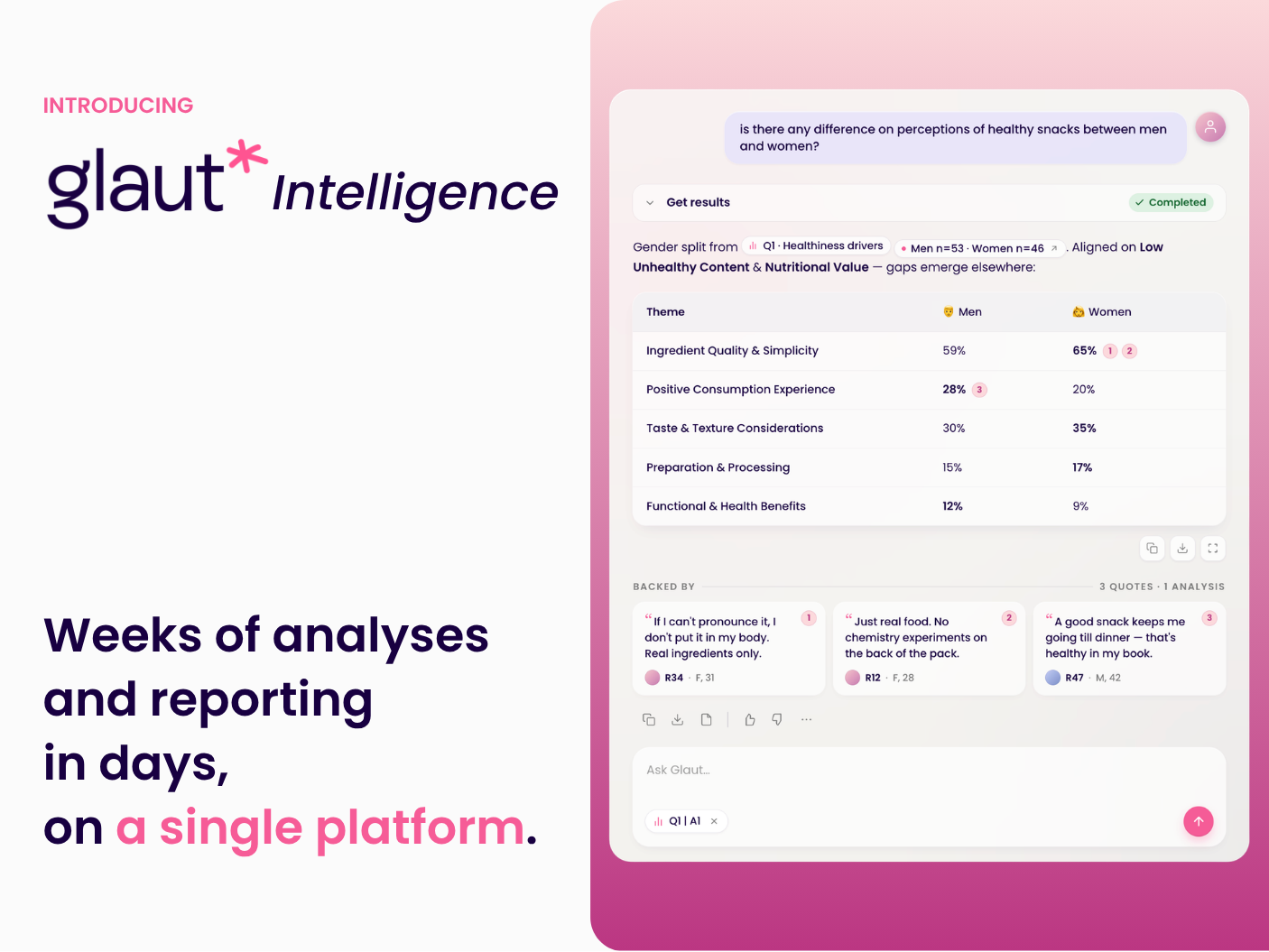
That is the problem Glaut Intelligence was built to address.
Today, analysis often happens across a fragmented stack:
- One tool for survey data
- Another for open ends
- Another for tables
- Another for charts
- Another for the final deck.
Each handover creates more work, and every manual transfer creates more room for mistakes.
The result is a strange contradiction: researchers are under pressure to move faster, but the process they rely on still asks them to slow down at the very moment when speed matters most.
The answer cannot be another ‘AI black box’
There is another tension, too. The answer cannot be a black box.
Research teams do not need outputs that they cannot interrogate. They need a way to move faster while keeping control over the reasoning. They need to know where each chart came from, which verbatim statements support each claim, how responses were coded, and what changed between versions of a report.
That is why the future of research analysis should not be framed as full automation. It should be framed as a better division of labour.
Glaut Intelligence handles the grunt work of analysis: structuring the plan, coding open-ended responses, generating tables, surfacing patterns, testing hypotheses and drafting a working report.
The researcher remains responsible for the judgment layer: checking the evidence, applying context, deciding what counts as a finding and shaping the final client narrative.
This distinction matters.
Glaut Intelligence gives researchers time back for judgment
A useful analysis system should not try to remove the researcher from the process. It should give them more time to think. It should make the evidence easier to inspect. It should shorten the path from raw data to the report draft without reducing accountability.
That is also why auditability is central. Every data point should trace back to its source. Every claim should be open to review. Every coding decision should be editable. Different versions of a report should be visible, not lost in a chain of files named “final_v7_real_final”.
In practical terms, this changes the project’s rhythm.
Instead of starting analysis from a blank page after the field closes, researchers can start from an approved analysis plan. Instead of rebuilding tables manually each time a new question comes in, they can interrogate the same dataset directly. Instead of treating open-ended responses as a separate qualitative appendix, they can be incorporated into the broader evidence base.
The goal is not to make research feel less human. It is to make the human part easier to protect.
The best researchers are not valuable because they can copy tables into slides faster than anyone else.
They are valuable because they can understand what a client is really asking, separate signal from noise, challenge a weak interpretation, and turn evidence into a clear recommendation.
When analysis workflows are slow, fragmented, and hard to audit, that value gets squeezed into the margins. When the grunt work is compressed, researchers get time back for the work that actually moves the project forward.
That is the principle behind Glaut Intelligence: faster analysis while the researcher remains in control.
Glaut Intelligence is now available to research teams who want to test a more reviewable, evidence-based approach to moving from fieldwork to findings: request 1 month of free access to Glaut Intelligence here.

We hope you enjoyed this article.
Research Live is published by MRS.
The Market Research Society (MRS) exists to promote and protect the research sector, showcasing how research delivers impact for businesses and government.
Members of MRS enjoy many benefits including tailoured policy guidance, discounts on training and conferences, and access to member-only content.
For example, there's an archive of winning case studies from over a decade of MRS Awards.
Find out more about the benefits of joining MRS here.