


Research Live Industry Report 2026: The agency view

In many ways, 2025 was a challenging year for the research and insight sector. Continued economic uncertainty has resulted in difficult trading conditions for some client sectors, including a slowdown in budget decisions that has had a subsequent negative impact on agencies.
However, it’s not all doom and gloom. In the second half of 2025, a more stable fiscal environment resulted in increased confidence for many businesses. Importantly, agencies responded to market conditions by adopting new approaches and refreshing or redefining their commercial offer. It feels like an inflection point – or at the very least, an opportune moment for reflection; for agencies to assert their value.
Increased complexity
With 2025 being an uphill struggle for most agencies, Suzy Hassan, managing director and co-founder at Potentia, reports that the company found the first half of the year “slow-moving” in terms of decisions and budget sign-offs but says this has improved latterly. However, she adds: “With the turbulent market conditions, we are well aware that the tides keep turning. To combat this, we are focused on launching new product lines in 2026 to broaden our offering, as well as improving our processes using the latest innovations and AI, where possible.”
Business conditions in research and insight are more complex in general, says Lewis Reeves, chief executive at Walr. “Post-2020 cautions and volatile conditions have continued, which make predicting outcomes harder than ever. This hasn’t stopped the ability to grow and make progress but has created a more complex environment. We see a mix of behaviours in the market, customers either in need of evolution, wanting to embrace change and spend to find the future state, or taking a more cautious approach, looking to ride out the storm before the new normal presents itself.”
Boxclever director Kathryn Boxall agrees it has been a hard year for many agencies. “The market is challenging and each brief feels harder fought and the decision-making process seems longer from a client perspective,” she says. “We have seen fewer very large strategic projects coming through which probably reflects budget restraints from some clients. Having said that, the last quarter has been particularly strong, so fingers crossed conditions are looking more positive.”
New thinking
In response to the sector’s sample quality challenge, Potentia launched several niche panels that are qualitatively recruited. Hassan says: “This brings fresh, high-quality sample back to the forefront of our offering and by focusing on hard-to-reach groups such as tradespeople, landlords, farmers, carers and healthcare professionals, we are developing quantitative research solutions among audiences that potentially go unheard.”
Following the acquisition of advanced analytics specialist SigDiff in 2023, Potentia also acquired survey operations business DataTree in 2025. The additions have strengthened the company’s in-house expertise and allowed it to offer a more comprehensive service, and it has also had a clear focus on employee engagement – Hassan says investing in its people has directly impacted company growth. She says: “Focusing on company culture has been key to our growth as a business this year. By building and maintaining a happy team, we are in turn able to boost client satisfaction.”
For Walr, operating internationally has been a major growth driver in the past year, according to Reeves. “Going both east (Australia office) and west (US office), the fruits of our labour are beginning to show and driving significant impact for our global results,” he says. “While there is certainly caution across the world with research spend, due to global volatility, there appears to be greater bullishness and willingness to spend in markets other than the UK.”
With geographical expansion a major avenue for growth and new business, Reeves adds that the company has had “a big focus on how we take our learnings, from arguably the most prestigious research market in the UK, to other regions”.
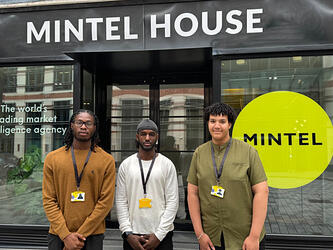
Mintel acquired Black Swan Data in 2025. Julie Lizer, president of global research and insights at Mintel, says the move was the result of Mintel making a “strategic shift towards predictive intelligence” as it looked to extend its ability to advise clients and help them plan for the future. Lizer adds that the addition of Black Swan Data means the company can identify “emerging consumer signals” before they appear in traditional data sources.
Mintel has also developed advanced landscape and forecasting metrics using its Global New Products Database, used by clients to distinguish the prevalence and growth of product attributes.
GWI has had a focus on embedding its data into the work processes and tools used by clients, including AI models. Tom Smith, chief executive at GWI, says the rise of agentic AI has opened “a new frontier”, adding: “We’re preparing for a world where, one day, there may be more customers who are agents than humans.”
Smith says GWI has evolved how its data can be accessed “to ensure that GWI data can provide crucial context to any question a person might have”. Smith adds: “Our focus has been on embedding GWI data into AI-first workflows so that any model or agent using our data reflects how real people think, feel and act.”
The company has also modernised its research infrastructure, including introducing AI-assisted methodologies to expand data collection, and increased its footprint to include more local markets.
Boxall says Boxclever has always driven its business through word of mouth and reputation, and she feels this stands it in good stead in difficult trading conditions. “When there’s nowhere to hide and you’re only as good as your last project, it’s in our interest to go above and beyond for your clients. When the market conditions are harder, this strategy serves us well as clients look for recommendations and a team they can trust,” she says.
In 2025, Boxclever launched five centres of excellence to reinforce the core areas it excels in, explains Boxall. “Internally, we know the areas we are strong at and we have also always been very honest with clients and turned down briefs that other agencies are better suited to. However, we recognised that this was the year to be brave and be explicit about this, so we set our stall out.”
In those five core areas, says Boxall, the agency knows what best practice looks like and can share case studies and relevant benchmarks, while being committed to investing in innovation. “Doing this has solidified our USP and brought clarity to clients as well as pushed us to keep advancing our thinking in these core business areas,” adds Boxall.
Challenges ahead
The temptation towards over-reliance on technology to deliver insights is the biggest risk for the sector in the year ahead, according to Mintel’s Lizer. “AI adoption has reached the tipping point, and there are promises everywhere that AI can meet all our needs. But this comes with a dangerous trade-off: we risk losing creativity and empathy in our insights, in exchange for speed and efficiency.”
Lizer says: “I’m a huge advocate for using technology to make our insights better and faster. The question is not whether to use AI, but how to use it wisely.” Lizer draws comparisons with social media ‘echo chambers’, saying she sees a similar risk from over-using AI to develop insights. She adds: “Using models trained on existing data and patterns means we will miss the ‘blue sky’ ideas that humans generate to fuel novel solutions. We need that human creativity to uncover the unexpected.”
Boxall also flags the need for the sector to respond effectively to new technologies. “I know AI is top of everyone’s mind, but any new tech advancement makes agencies reassess their position in the market and that is no bad thing. As we have seen before, the danger zone for agencies is when they are unclear about their positioning or maybe trying to be all things to all people. Boxclever is in the consultancy end of this sector, so our challenge is to ensure we embrace the brilliant opportunities that AI offers to strengthen and support our offering. My warning would be not to jump too quickly and undermine our profession, so we become a commodity.”
Potentia’s Hassan sees data quality as the biggest challenge facing the industry. She says: “We are at the stage where we need to invest in tools and processes to completely re-address the way we approach data cleaning within digital surveys. Using AI to improve data quality is addressing part of this challenge, but doesn’t solve it entirely, so we are still heavily reliant on the attention to detail of our project management team.”
GWI’s Smith says the challenge for 2026 is for the industry to evolve – or risk irrelevance. “We’ve reached what some are calling ‘peak AI’: a point where AI can no longer evolve meaningfully without access to new, high-quality human data. AI models have already scraped the internet. What they need now is real, representative, unbiased human insight, and that’s exactly what our industry produces. But much of the market research world is still operating on outdated models, creating incredible data that ends up locked away in silos or static reports.”
To address this, says Smith, the insights sector must “embrace technology, automate intelligently, and deliver data in ways that AI systems can use continuously, ethically, and at scale”. Those who can combine AI with human authenticity, will, he argues, “redefine what it means to provide real understanding”.
For Walr’s Reeves, the core challenge remains what he sees as the same as it has always been – to not only remain relevant, but to become critical to business decisions and growth. He says: “The ways in which we achieve this are changing rapidly, but with this brings opportunity to become even more critical, thanks to speed and volumes of data we can analyse for crucial insights, almost instantly.
“Data is more abundant than ever, the desire for data-driven decisions is the greatest it’s ever been, and the tools to bring this together, to cut out the noise and provide extreme value, are fantastic. 2026 is our opportunity to harness this and stamp our critical authority on this changing world.”

We hope you enjoyed this article.
Research Live is published by MRS.
The Market Research Society (MRS) exists to promote and protect the research sector, showcasing how research delivers impact for businesses and government.
Members of MRS enjoy many benefits including tailoured policy guidance, discounts on training and conferences, and access to member-only content.
For example, there's an archive of winning case studies from over a decade of MRS Awards.
Find out more about the benefits of joining MRS here.








0 Comments