


Creating cohesion through community insight

The summer of 2024 was an extremely difficult one for the UK. The Southport attack on 29th July provoked one of the largest and most widespread periods of disorder in more than a decade, fuelled by false claims that the perpetrator was an asylum seeker.
The days that followed saw rioting across the country, including in Southport, driven by racist, anti-Islam and anti-immigration sentiments among followers of the far right. More than 1,200 arrests were made in the weeks that followed.
For many people, it showed the fraying threads in the tapestry of British society, and highlighted the urgent need for solutions to help address weaknesses in the UK’s social cohesion. The result was a piece of research led by think tank British Future and civic organisation the Belong Network.
Jake Puddle, director of research at British Future and co-author of The State of Us, published in July 2025, says the research aimed to provide a ‘state of the nation’ overview of UK community cohesion in the context of the far-right riots. “We wanted to try to delve a little bit deeper into what the drivers of those tensions are and to try to understand some of the antidotes to polarisation, both in terms of what the public want to see, but also in terms of what kind of initiatives or organisations are doing work to bring people together across divides.”
The overarching aim of the project was to speak to people at a community level as well as at the stakeholder organisational level. This would then help to identify policy priorities for government, feeding into the ongoing Independent Commission on Community Cohesion, convened in June 2025 by the Together Coalition and co-chaired by former Conservative chancellor Sir Sajid Javid and former Labour MP Jon Cruddas.
On the road
The team at British Future sought to speak to people from across the gamut of British society and across geographical regions. The research involved a nationally representative survey of 2,243 UK adults and eight focus groups featuring a total of 71 participants. The researchers held further focus groups in 60 towns and cities across the UK, including in areas that faced riots, to assess public attitudes to social cohesion.
The researchers also supplemented this evidence with 15 roundtable discussions with 177 stakeholders across the regions and nations of the UK, as well as 113 written submissions of evidence and a literature review of existing studies and publications.
“The public report feeling less aligned to mainstream political parties and sceptical of their likelihood to deliver meaningful change.”
The groups were a key segment of the research, says Puddle. “We structured the focus groups to ensure that, attitudinally, we had people from different backgrounds, and it opened up some really useful, constructive debates among people who probably never had an opportunity to talk about these themes in a mediated space before. You could see them taking on one another’s views and trying to traverse quite contentious issues themselves, possibly for the first time, and relate to one another.”
The report found that people’s perceptions of community cohesion outside their immediate neighbourhoods was often pessimistic and anxious, with focus groups underlining the existence of a weaker sense of community at town, city or national level. Concerns about the economy, public services, inequality and the cost-of-living crisis fuelled frustrations about the ability of politics to affect change.
Polarised debates on issues such as asylum and immigration also divided people, exacerbated by heated media and online debate, and trust in decision-makers was very low. “Politicians are seen as self-interested and disconnected from public concerns,” the report says. “Across the UK, the public report feeling less aligned to mainstream political parties and sceptical of their likelihood to deliver meaningful change.”
Puddle says that these factors amounted to a “toxic cocktail” that has lead to increased polarisation, and in the worst cases, disorder on the scale of that seen in 2024. In 2020, British Future released a report on social trust (Talk/Together), and Puddle notes it was striking “just how much political trust had declined even further [since 2020 ], particularly with regards to kind of trust in mainstream parties to make a difference”.
In addition, the research found that almost a third of those surveyed rarely or never had any opportunities to meet people from a different background to themselves. “About half actually said that they could rarely afford to go out into their community to interact with others at pubs, cafes, or community spaces,” Puddle adds. “We feel that’s a problem, because social contact is one of the best antidotes to prejudice, and because you can’t hate up close when you’re meeting and mixing with others on a regular basis.
“One of the legacies of Covid-19 is people interacted with their neighbours a bit more, and there was a collective memory of coming together in a sort of ‘blitz spirit’ during a really difficult time. We found that people tended to talk in focus groups about quite positive experiences [on] their street or their estate, and seven in 10 people in our polling said that at that kind of hyper-local level, they felt people from different backgrounds did get along together pretty well.”
However, the picture is not the same everywhere and was not as positive in the areas that were more deprived or were lacking in community infrastructure including youth clubs and meeting spaces, said Puddle.
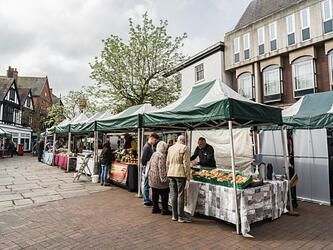
It is perhaps unsurprising then, that the survey found that the most popular option for improving social mixing and community strength was improving shared spaces such as parks, high streets and libraries, with almost a third ( 31%) of participants rating this as their first choice.
Social media can often play a role in perceptions of what life is like in large cities, towns or in other parts of the UK. Facebook pages, for example, often highlight extreme views or negative depictions of areas. Puddle says that comments on issues such as new housing, accommodation for asylum seekers or local crime often lacks a “direct day-to-day social contact for people to contrast what they’re seeing online with a lived reality”; a problem exacerbated when talking about the country as a whole.
Bridging divides
The report set out several key reflections to help build community cohesion, shared identities and pride. One was a long-term national plan for cohesion, updated to reflect new challenges and opportunities, with funding available.
The researchers also recommended that the commission explore how policymakers could adapt immigration and asylum policy to work better for both new arrivals and the communities they join. The report says: “There is a need to create space for discussion of immigration within clear boundaries that exclude racism, misinformation and violence from our national conversation.”
“People tended to talk in focus groups about quite positive experiences at the level of their street.”
The report also recommended that the commission considers efforts to address the spread of online misinformation and hate, and explore how to restore public trust and respect in politics.
There is an argument for helping people at a local level to help address issues within their communities, and the researchers experienced “a real energy and sense of creativity from lots of grassroots groups” says Puddle, from community development charities to arts organisations and sports clubs. “They are really actively trying to take people across divides and say, look, you don’t need to talk about your differences all the time. There’s a lot of energy and support at that local level out there to try to take the temperature down on some of these issues of polarisation.”
Equally, there needs to be a national focus on cohesion, starting with a government strategy for improving the situation, says Puddle. “We need a much more proactive and a more sustained policy focus on cohesion, to come up with a national strategy of how to resource effective community work and how to take seriously these national issues of misinformation, divides over asylum and trust in democracy and politicians.
“We’re trying really hard to advocate to government to come up with that strategy and do so soon, because this disorder can bubble up again and these tensions aren’t going away.”
- This work won the President’s Medal at the MRS Awards 2025. You can see a list of all winners by visiting the MRS Awards website.
- The MRS Awards is currently open for entries for 2026, with a deadline of 25th June.

We hope you enjoyed this article.
Research Live is published by MRS.
The Market Research Society (MRS) exists to promote and protect the research sector, showcasing how research delivers impact for businesses and government.
Members of MRS enjoy many benefits including tailoured policy guidance, discounts on training and conferences, and access to member-only content.
For example, there's an archive of winning case studies from over a decade of MRS Awards.
Find out more about the benefits of joining MRS here.








0 Comments