


Challenging expectations: The insight behind the Currys ‘Sigh of Relief’ ad
There is an innate human need to feel seen, understood and well catered for. Yet brands often fall short of ensuring that their advertising is accessible and inclusive.
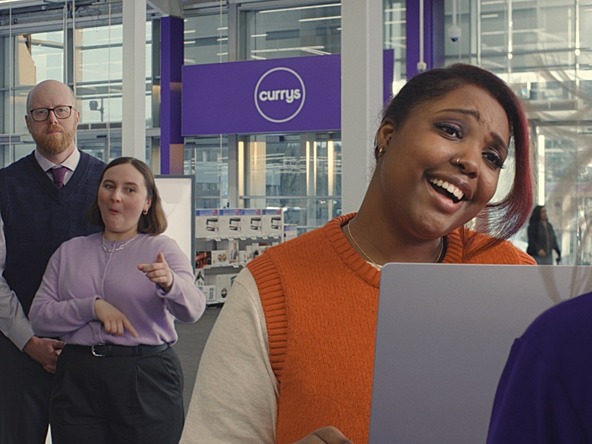
An advert for technology retailer Currys centred on the concept of the huge relief felt by people with accessibility needs when they feel supported while shopping for appliances.
‘Sigh of Relief’, one of the brand’s strongest-performing ads in terms of return on investment for sales, was informed by inclusive insight and co-produced with people from communities with accessibility needs. The finished spot went beyond on-screen representation, featuring British Sign Language interpretation and audio descriptions.
Advertising agency AMV BBDO, research agency Open Inclusion and disabled co-producers co-created the ad, and the insight underpinning the work involved an in-depth research process to inform the creative direction, with collaboration with communities at multiple points.
The film (linked above) originated from a strategic partnership between AMV BBDO and Open Inclusion that focuses on informing the creative agency’s approach with ‘radical listening’. Christine Hemphill, managing director at Open Inclusion, explains: “It really shouldn't be very radical, but it’s just not industry practice to engage with people with more diverse and specific perspectives – most specifically disabled people – and to inform campaigns – not just disability specific and centred campaigns like the Currys one, but broader campaigns – to be more accessible and inclusive by default.”
Early and collaborative engagement
With their partnership already in place, AMV and Open Inclusion pitched for (and won) Channel 4’s 2024 Diversity in Advertising opportunity, an annual prize awarding £1m in advertising space for the brand to best respond to its brief. That year, the competition challenged brands to be more accessible in their advertising and inclusive ‘by design’.
Open Inclusion was also already working with Currys prior to pitching the idea, as the brand was focusing on improving its retail environments from an accessibility perspective, says Hemphill, making it a “natural” idea to pitch.
Hemphill says: “We already had a client that was not just engaged, but working hard to improve their own environments, which I think is key to authentic advertising – not just having a good ad that showcases a good experience, but actually represents the reality of a good experience.”
Before the idea went into the pitch, Open Inclusion held a couple of focus groups to explore what would make a fun, creative ad. At that point, the company also engaged disability strategist Breandan Ward, and Laura Goldberg, who leads the deaf/hard of hearing and BSL users community at Open Inclusion, to also get their insight and feedback on their ideas.
Before the idea was submitted to the Channel 4 award, the team engaged with Open Inclusion’s group of community leaders and co-researchers, who represent different areas across disability including chronic health, mental health, neurodiversity, dexterity, mobility, sight loss and hearing loss.
“Even though the narrative was already oriented towards two, we got that pan-disability perspective early on,” says Hemphill. “Of course, good customer service and some of the things showcased there are just about respect and intent, and that’s true for any one of those communities as much as the other.”
The research process involved directly working with the deaf and hard of hearing and blind and partially sighted communities, led by Ward and Goldberg, with focus groups designed to be as diverse as possible – for example, age diversity, whether people use guide dogs, whether they have been blind from a young age or more recently – to ensure a range of perspectives from across different UK regions.
Hemphill says it was beneficial to have people involved in the research who were “prepared to constructively work through differences”. She explains: “Some people will be more spiky and specific in their perspective than others, which is fine. But we needed people that were not just right – but they're happy to input into a better right. And you don't always get that right first time.”
Making the ad accessible by design also meant challenging people’s expectations of what they are used to with ads – for example, having on-screen narration, rather than the brand publishing a separate, audio-described version of the ad on YouTube. “When you’re being really innovative, you're also challenging the norm in a way that can confront people.”
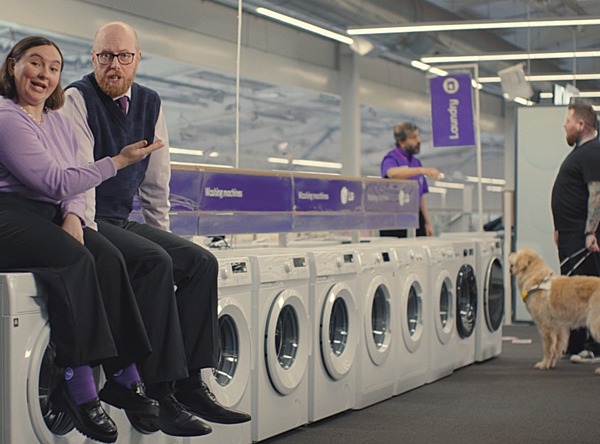
Image caption: Still from Currys ‘Sigh of Relief’ ad, with two characters (a BSL interpreter and an audio describer) sitting on washing machines in the foreground and two characters (a customer with a guide dog and a Currys member of staff) speaking in the background
The researchers also put together a new group at the end to review the work of those who had been involved in discussing and debating, to ensure that the creative would resonate. Hemphill says: “Sometimes, by working through ideas and leaving them on the cutting room floor, you know the ideas that were worked through that got on the cutting room floor but are no longer left in the creative. That means that the creative that’s left might not represent the perspective that you expect it is, because people come to it with that knowledge. And if people come to it fresh without that knowledge, they say: ‘No. This isn't going to land like that.’”
Lastly, the process involved stepping outside of the Open communities and working with RNIB and RNID to get a fresh perspective from some of the leaders representing those communities.
Strong roots
Inclusion is often treated as a bolt-on. But it should be the foundation of good research and advertising, says Ward. “The word ‘radical’ comes from the word for ‘root’. We believe at the root of good research, at the root of good advertising, at the root of good customer engagement is inclusion and accessibility.”
The empathy required for inclusive work needs to be informed, says Hemphill. “It doesn't turn up by accident. We don't live other people’s lives. Within disability, speaking to one person with disability will not represent the experience of that disability in an authentic and robust way.”
“And I think that’s where the research has such a powerful part to play in good, authentic, creative content, because it’s so often that tinsel on the end that rather than rooted, grounded, and diverse listening.”
To illustrate her point, Hemphill says not everyone in the sight-loss community involved in the research agreed with the creative. This highlighted the importance of having Ward and Goldberg as co-producers, as leaders of those communities, to navigate the diversity of perspective and differences of opinions – particularly when humour is involved, but also to convey the range of opinions about what good customer service means, or what products are good. “You need someone to navigate that with credibility and confidence and personal and professional experience to be able to get to insight, not just input,” adds Hemphill.
“At the root of good research, good advertising and good customer engagement is inclusion and accessibility.”
When inclusion and accessibility is in the roots of the work, it feeds into everything else that grows, says Ward. “It was co-production because it wasn’t just talking about what we were going to do and what the goal was. It was also [asking] how are we going to navigate this? And that’s often where it gets messy.”
Hemphill says inclusive research is often about “progress over perfection”, and says that navigation, those layers of input from people with different experiences and professional backgrounds, ultimately led to positive outcomes. “There is no perfect, there is no ‘here’s the right answer’. But the friction-filled process, with the right kind of positive and productive friction, is where the magic happened.”
Changing tack
Relationships played a key role – not only the relationship between the co-producers and the communities, but also between Open and AMV. Hemphill credits the history of the relationship in helping the team navigate difficult decisions and transforming ideas through early input, not just as the creative was developing, but also to inform decisions such as which products to showcase in the ad; they were selected on the basis of input from the community.
“We had four years of engaging with different people in the team, of doing share back sessions with them, sharing things outside of this particular piece of a particular client work to build that readiness for them to hear the insight,” says Hemphill, who feels the job of a researcher is “to create a really beautiful pipeline between those that know and those that need to know”.
She adds: “My job’s neither to know nor to act on what is past; my job is to create the space for that knowledge to transfer. Sometimes that requires some translation and, I think, almost always in disability inclusive research, that requires constant support for the person listening to understand – and to make space for them to understand – a bit more broadly how important the things are.
“Sometimes that is ‘which of these hills do you want to die on?’ You have to pick the [things] that are going to be most important because there is no right answer here. There is a better outcome.”
- MRS is hosting a webinar about the Currys campaign on 21st April, featuring speakers from Open Inclusion and AMV BBDO. Find out more and book on the MRS website here.
- Open Inclusion, AMV BBDO & Currys won the Jeremy Bullmore award for creative development research at the 2025 MRS Awards.
Images supplied courtesy of Currys, AMV BBDO and Open Inclusion

We hope you enjoyed this article.
Research Live is published by MRS.
The Market Research Society (MRS) exists to promote and protect the research sector, showcasing how research delivers impact for businesses and government.
Members of MRS enjoy many benefits including tailoured policy guidance, discounts on training and conferences, and access to member-only content.
For example, there's an archive of winning case studies from over a decade of MRS Awards.
Find out more about the benefits of joining MRS here.









0 Comments