


Change your mind: AI inevitability and aversion to friction
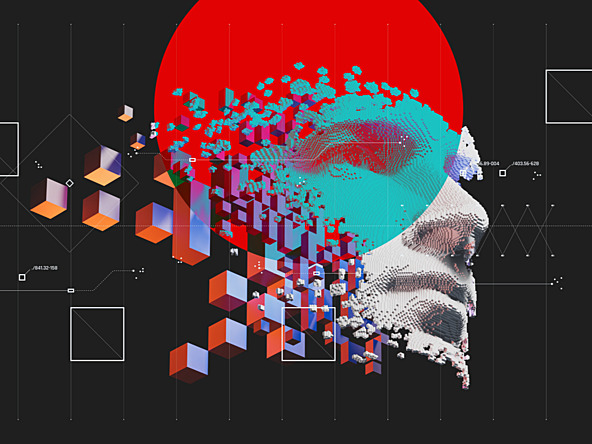
Propaganda and the American dream have long been inseparable. Today, the persuasive patter of advertising and public relations permeates every aspect of discourse. Proponents of AI have exploited this pervasive style; but I am interested in only one technique they employ. That technique – a masterful move of mental trickery – is called ‘determinism’.
A strange sentiment slips in midway through Dario Amodei’s essay Machines of Loving Grace. Hidden in an evangelical litany on AI’s potential, Amodei unnervingly observes: “There is indeed something overdetermined about it [AI], as if many different attempts to imagine a good world inevitably lead roughly here... Competition is self-defeating and tends to lead to a society based on compassion and cooperation... Basic human intuitions of fairness, cooperation, curiosity, and autonomy are hard to argue with, and are cumulative in a way that our more destructive impulses often aren’t.”
The assertion is not only baseless and blasé: it is misleading. Throughout history, fairness and cooperation have lost many hopeful arguments to more vicious ends. Indeed, seldom has it seemed less likely that our better angels will persevere.
Yet something stranger is at play – notice how ‘inevitability’ is casually introduced. This is technological determinism, used as a technique to create acquiescence.
Manufacturing AI acceptance
Determinism is an artful device: Unlike an assumption, it does not frame itself as unfounded. It presumes itself to be true. It eschews all counter arguments to coerce a certain outcome. It has a soothing, quieting effect, serving as a sugar coating, concealing the taste of discomfort and barely interrogated ambivalence. In this way, it is – fittingly – an artificial technique; it manufactures acceptance.
I see its effect everywhere as a researcher into the human experience of digital space: AI inevitability met with apathy, even while it is leveraged to reshape daily lives.
The entire endeavour
Why is this surprising? Researchers are not apathetic, we challenge assumptions. This is the entire endeavour.
Research thrives through friction at every stage. At inception, research acknowledges that an unresolved and complex problem is at stake. Throughout research we insistently ask ‘why’, remaining open to new and conflicting ideas. The realities we uncover are often abrasive and difficult to synthesise, rich with the idiosyncrasy and unpredictability of human nature. Finally, we force another kind of friction when our findings create change. Yes, technology is a disruptor, and so is research.
Friction is fundamental to research
The icons of research have friction as their very foundation. One of the most seminal and haunting works of ethnography, A Thrice Told Tale by Margery Wolf tells the story of a mother in a Taiwanese farm family who began to behave in an aberrant suicidal manner, as if possessed by spirits. Wolf uses three texts: fictional story, anthropological field notes and a social science article.
Each retelling uncovers a different meaning: the woman (Tan A-mei) is on a spiritual path to become a shaman (tang-ki), her unemployed husband is exploiting her, or, she is experiencing mental illness. Wolf includes chapters on the dynamics of power, reflexivity and representation in ethnographic texts. She conveys the slipperiness of interpretation and makes it clear that the difficulty of research does not end when fieldwork stops.
Real research uncovers raw and competing realities – if it’s uncomfortable, it has succeeded. Meaning, when researchers who thrive in friction find themselves struggling to challenge determinism, we must ask why.
Preconditions for passive adoption
We are vulnerable to determinism because we are already far along a certain cultural trajectory.
In Amusing Ourselves to Death, Neil Postman’s prescient interrogation of the effect of television on society, Postman notes: “When a population becomes distracted by trivia, when cultural life is redefined as a perpetual round of entertainments, when serious public conversation becomes a form of baby-talk… a nation finds itself at risk.”
A society investing attention in the sensational, the soporific, the fleeting, the artificial and even the incoherent is an ideal context for AI adoption. An appetite to outsource literate, critical capacities only exists in certain contexts. A culture that has devalued difficulty, depth and friction is the precondition for AI to be accepted with apathy.
Efficiency at what cost?
Why does this matter? There is a tipping point when a tool is so prevalent that it becomes our environment and alters our essence. The sociologist Jacques Ellul – writing six decades ago on propaganda and technology – identifies how machines reshape us: “Technique has penetrated the deepest recesses of the human. The machine tends not only to create a new human environment, but also to modify man’s very essence.”
This is why outsourcing deep and difficult thought processes is different to simply adopting a new ‘tool’. When analytic faculties fade, we lose something integral to ourselves, our environment, and – dare I say – our souls. We become more mechanised.
Velocity and volume vs richness and resonance
What does outsourcing truly mean for research, its richness, its texture, its quality and its ethos? Aside from the fact that AI insight platforms, fed with our research data, train big tech’s proprietary models.
According to Engel’s law, any phenomenon that increases volume and velocity also reduces quality. However, it is not simply standards that degrade. Other changes occur with wider implications: our relationship to insight alters, whether we assimilate and understand it, its role, its value. Does it merely scintillate or truly resonate?
We should be less concerned with replacement and instead be alert to research being reduced.
Research as refuge and disruption
In an ever more artificial culture, research is a refuge for deep thinkers and truth tellers: professionals who are wide awake. Our reluctance to challenge and reshape the ‘inevitability’ narrative risks eroding this.
Luckily, if anything can redetermine and redefine how machines mould our society, it is the disruptive power of the research discipline.
The question is, are we still able to tolerate a little friction, particularly in the name of change?
Kate Charles is a user research and insight professional

We hope you enjoyed this article.
Research Live is published by MRS.
The Market Research Society (MRS) exists to promote and protect the research sector, showcasing how research delivers impact for businesses and government.
Members of MRS enjoy many benefits including tailoured policy guidance, discounts on training and conferences, and access to member-only content.
For example, there's an archive of winning case studies from over a decade of MRS Awards.
Find out more about the benefits of joining MRS here.









0 Comments