
Beyond job titles: Why responsible AI in B2B recruitment starts with validated participant selection
In market research, the conversation around AI is often dominated by speed, scale and automation. In specialist B2B recruitment, however, none of those benefits matter if the wrong people are invited to participate in the study. The more useful question is not simply whether a recruitment platform uses AI, but what that AI is built on and how far human judgement remains in control.
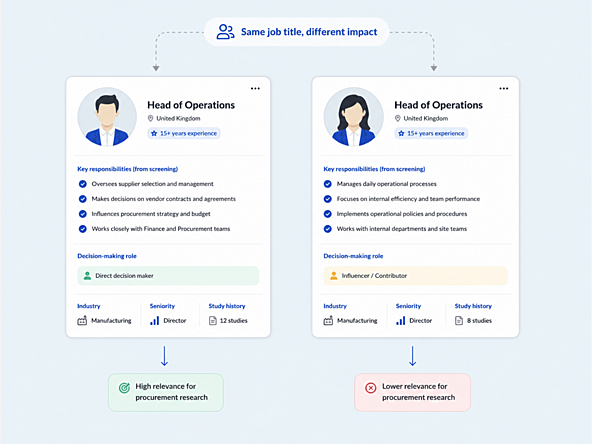
This distinction matters because B2B recruitment has never been a simple matching exercise. A job title may indicate seniority, but it does not reliably show what someone actually does, which decisions they influence, or whether their experience is relevant to a specific research question. Two people with the same title can have very different responsibilities. One may control supplier selection and budgets, while another may focus mainly on internal processes with limited influence over decision-making.
For complex, multi-market studies, these differences shape sample quality. Conventional keyword searches and title filters can surface profiles that look suitable on paper, while overlooking professionals whose real responsibilities make them highly relevant. The challenge becomes even greater when the audience is niche, geographically dispersed or difficult to reach.
This is where AI can make a meaningful difference, but only when it starts with dependable participant selection.
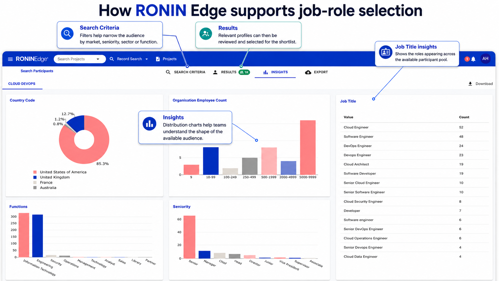
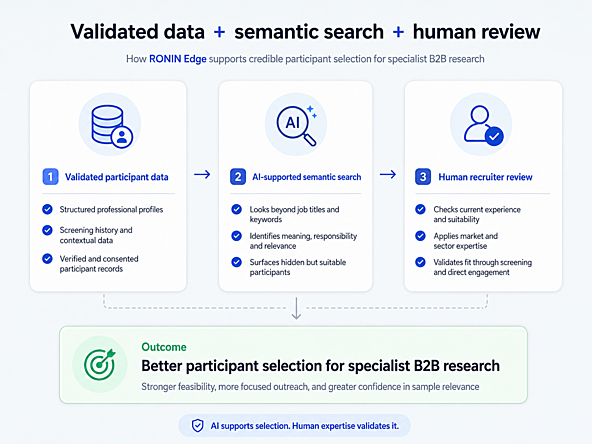
RONIN Edge is built around this principle. It draws on a verified and consented participant database that combines structured professional profiles, screening history and contextual information gathered through RONIN’s research operations and project delivery.
Records are standardised and reviewed, with information such as seniority, organisation type, market, professional experience and previous study history creating a controlled foundation for search. The network includes more than 400,000 professionals across multiple countries and disciplines, providing both breadth and specialist relevance.
On top of that foundation, AI-supported semantic search within RONIN Edge helps teams move beyond exact wording. Traditional search looks for the terms entered; semantic search looks for meaning. It can interpret anonymised survey screening responses and identify evidence of responsibility, influence, technical expertise, product experience or involvement in a business process, even when a participant uses different language from the research brief.
This changes how audiences can be defined. Instead of searching only for a specific job title, a researcher can look for people who have led supplier selection, influenced technology investment, managed a particular operational challenge, or participated in a defined decision-making journey. This supports more realistic feasibility assessments and helps recruitment teams identify relevant professionals who might otherwise be hidden in conventional database searches.
However, an AI-generated match is not the same as a validated participant.
Specialist recruiters still need to assess whether an individual’s experience is current, whether their responsibilities align with the brief and whether they can contribute meaningfully to the discussion. They must understand nuance, resolve ambiguity, apply market and sector knowledge, and verify suitability through screening and direct engagement. Human review is not an administrative final step; it is the quality layer that turns an intelligent search result into a credible research participant.
This reflects a broader principle for AI in research operations: augmentation is more valuable than replacement. AI is most effective when it reduces repetitive manual work, organises complex information, and directs expert attention towards the profiles most likely to be relevant. It is less credible when treated as a substitute for the judgement, reassurance and accountability that skilled research professionals provide.
For clients, the benefit is not automation for its own sake. It is greater confidence at the start of a project: stronger feasibility checks, more focused outreach, and a clearer understanding of why each participant is relevant.
Recruitment teams can spend less time reviewing unsuitable profiles and more time validating the people most likely to generate useful insight. For hard-to-reach B2B audiences, that can improve both delivery efficiency and the quality of the eventual research conversation.
As the industry considers the next phase of AI-powered insight, the debate should move beyond whether AI is being used. The more important questions are whether the underlying data is reliable, whether the process is controlled and whether experienced people remain accountable for the outcome.
That is the role RONIN Edge is designed to play. It does not replace specialist recruitment expertise. It strengthens it, using AI to unlock the meaning held within validated participant information while keeping human judgement at the centre of every recruitment decision.
Simon Glanville is managing director at RONIN International

We hope you enjoyed this article.
Research Live is published by MRS.
The Market Research Society (MRS) exists to promote and protect the research sector, showcasing how research delivers impact for businesses and government.
Members of MRS enjoy many benefits including tailoured policy guidance, discounts on training and conferences, and access to member-only content.
For example, there's an archive of winning case studies from over a decade of MRS Awards.
Find out more about the benefits of joining MRS here.