


Delphi perspectives: AI and authority – who owns understanding?
Within an AI-enabled economy it is the truth that is scarce, among a wealth of insight. Every innovation throughout the information age has led to a shift in who gets to authorise this truth, be that the printing press or the internet.
As we face the next seismic shift in our profession, we must seize control and define the standards of understanding ourselves, and not allow others to define them through speed, cost and convenience.
It would be easy to view this as a threat to our profession – a shift where the insights function is treated primarily as a quality-assurance unit, auditing and verifying models and outputs. We argue that it in fact reshapes the dynamics in our favour as the human skills required in the insights space shift from production to discernment: knowing which questions matter, which outputs to trust and what it all means for the business.
A shared accountability
There is a danger that authority over insight migrates away from those trained to understand evidence, method and human context as AI tools are sold to senior leaders, procurement teams and commercial functions whose focus is on speed, scale and cost reduction. On this basis, there is a risk insight teams become positioned as late-stage validators rather than upstream authorities.
True authority must be redefined as stewardship rather than ownership of insight. By reshaping our roles and focusing on what we do best, we can share the burden of authority and safeguard true understanding.
The AI insight stack
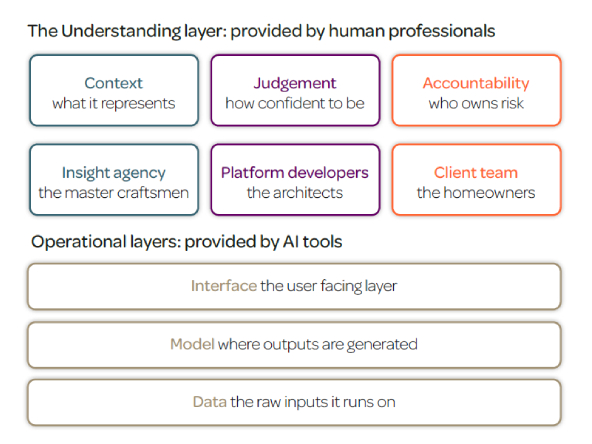
The ‘AI Insight Stack’ (see diagram) helps explain this shift. Standard AI tools focus on three operational layers: the data, the model, and the user-interface. What they lack is this crucial ‘understanding layer’ that our profession provides.
This human understanding layer relies on three core structural responsibilities: context (what the tool represents), judgement (confidence in the output) and accountability (who owns the risk if a decision fails). Each of which align very nicely with the three key insight groups of insight agencies, platform developers and client teams.
The real value of a researcher does not lie in policing how a tool is built, but in managing the commercial risk of the decisions made from it. We need a system where accountability is shared across the research pipeline, rather than forcing researchers to check every automated report.
By dividing these tasks, each partner carries a specific piece of corporate liability through clear structural hand-offs. This shared accountability allows each organisation to safely sign off on any insights tool, anchoring final authorisation in our core professional principles: transparency, confidentiality and independent judgement.
Three clear roles for a new hierarchy
To see how this works in practice, picture building a safe, stable home for the future of research. A reliable home does not rely on one person checking every nail; it relies on a trusted ecosystem of experts. Applying this logic to AI, the human understanding layer (context, judgement and accountability) is maintained through a clear division of labour:
1 ) The platform developers (the architects)
Developers and consultancies building enterprise tools must accept absolute liability for the blueprint. Their job is to design a secure framework, embedding corporate guardrails and compliant workflows into the platform. Just as an architect is legally accountable for the structural safety of a building, platform developers must get the digital architecture right, because at scale errors propagate as readily as insights.
By designing clear operational signals into the blueprint, they provide the foundation for judgement, helping the organisation gauge how confident it should be in the tool’s output. They are liable for ensuring the system processes data safely, protects privacy and operates reliably within set guardrails.
2 ) The insights agency (the master craftsmen)
An architect’s blueprint is only as good as the raw materials used to execute it. Insights agencies are the specialised craftsmen who source, carve and verify the baseline materials: the human data. Working to strict industry standards, they ensure only genuine, robust data feeds the machine, giving the framework its real-world integrity. Their role is to verify the training data and baseline contexts to ensure they are accurate and free from systemic bias and being used for the right job-at-hand.
Like any master craftsman this skill is nuanced. Human understanding it not only about accuracy, but plausibility. Human behaviours are not fixed, but contextual. And perhaps most importantly, needs and attitudes are transient and not set in stone within a foundation of training data. It’s not just about what data to use, but how, when and why to apply each source of data and how to get the mix right for each use-case.
By doing this they protect the context of the research, confirming what the tool seeks to synthetically represent, and for whom. In an automated world, their craft shifts from interrogating people to generate answers, to interrogating answers to ensure they can be trusted.
3 ) The client team (the homeowners)
The client team need not lay bricks or study technical schematics, nor worry about how the tool was built. Instead, they focus on the space they will live in, defining how the house must fit their daily lives. The internal insights team owns the living brief, setting the guardrails, standards and risk tiers for how research is conducted across the enterprise.
Authority in the AI era must be risk-tiered: the more consequential the decision being made, the more explicit the standards of validation and human judgement must become. Only the internal insights teams have the required knowledge to make these calls.
Because they carry the ultimate financial risk and must live with the final strategic decisions, their job is to act as the authority on usage. They validate how research is deployed, monitoring the build to ensure it delivers real-world business utility. The moment a tool’s outputs miss the commercial context, lack emotional depth, or fail to meet the organisation’s needs, the client team demands course correction, or halts production entirely. They wield the supreme corporate veto because they own the ultimate accountability, standing behind the final recommendation.
Upholding our principles: trust without re-verification
This collaborative framework is not a radical departure; it maintains the ethos with which clients, agencies and platform developers have always partnered. In a primary research project, a client-side buyer is never expected to check every raw interview record to verify its quality. Instead, the relationship relies on established professional standards and a shared commitment to robust outputs.
Generative AI does not change these fundamentals; it requires us to refresh how we apply them. By clearly dividing responsibilities, we uphold those core principles of our insights profession: transparency, confidentiality and independent judgement. When platform developers and agencies are fully transparent about how their tools are built and their models trained, the client team is freed from the operational trap of double-checking code.
The future authority of the insight profession will not come from owning every tool, checking every output or blocking every experiment. It will come from defining the conditions under which evidence can be trusted, decisions can be justified and human reality remains in view.
Ian Ralph is in insight innovation at the Human Understanding Lab at Walnut; Rose Tomlins is director at MTM

We hope you enjoyed this article.
Research Live is published by MRS.
The Market Research Society (MRS) exists to promote and protect the research sector, showcasing how research delivers impact for businesses and government.
Members of MRS enjoy many benefits including tailoured policy guidance, discounts on training and conferences, and access to member-only content.
For example, there's an archive of winning case studies from over a decade of MRS Awards.
Find out more about the benefits of joining MRS here.







0 Comments