


Haleon: Behavioural science should speak the language of users
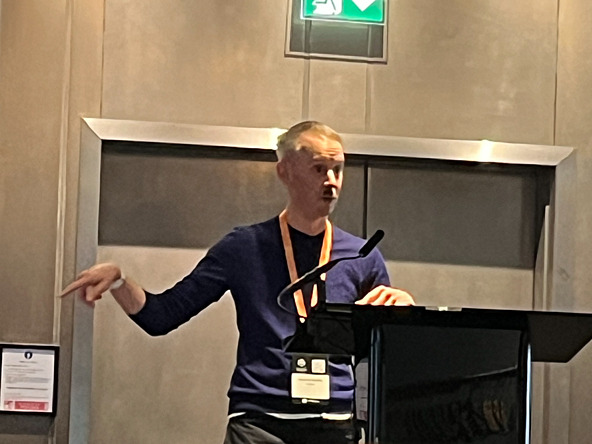
Speaking at the conference on Thursday 24th September, Benjamin Buckby, behavioural design lead, digital & tech, at Haleon, recounted five key lessons from spending the past two years trying to integrate behavioural science into digital and technology at the business.
Buckby said that the challenge for the behavioural science team was that commercial excellence teams needed to use the behavioural science tools to make the right investment and product choices, but there was historically poor adoption of products at Haleon for behavioural commercial, AI and data products, with only 2% of potential users adopting the tools.
The project saw the team successfully boost the adoption of behavioural science in those teams.
Buckby told the conference that the first lesson was to “get inside delivery”, noting that the previous attempt to integrate the discipline used a behavioural science centre of excellence with “gold standard best practice frameworks and principles”.
“The problem here was that [behavioural science] was pushed to these teams and tried to disseminate from a fixed centre, the centre of excellence,” Buckby explained. “Essentially, there wasn’t any hands-on with the product teams to embed this and put it into practice.”
Issues included that teams were too busy to understand the new techniques, and thus ignored it, with behavioural science guidance written in an “academic” and “evangelist” way, rather than aiming at being “practical” to the teams. There was a need to avoid having behavioural science as “an island that pushes stuff out” but to instead “put it inside the delivery system”.
“Behavioural science can’t have an impact as a centre of excellence, advisory service,” he added. “You need to get your hands in the weeds and get involved in the delivery.”
The second lesson, according to Buckby, was to find early adopters and early influencers to create entry points into the delivery system.
“Don’t try to open all doors in the organisation at once,” he said, adding that behavioural science evangelists should target people with problems that need solving in the organisation, those with decision-making power and potential platform influencers.
The third lesson was to use “windows of change” in the organisation as an opportunity for adoption, such as where value realisation is below expectations, where there is a new leader or product owner, and when operational models are being redesigned.
“Try to meet them in middle,” Buckby said. “Don’t give them a PhD behavioural science framework, but what is practical and speaks to that maturity level.
“We are trying to go from one to two – from limited maturity to having some maturity. Where it fell flat before, we were trying to go from one to 10 – there was too much of an uplift.”
The fourth lesson was to overcome resistance by changing the proposition. “What I learned is don’t sell the discipline,” said Buckby. “Don’t say you will sell behavioural science – no-one cares. It is connecting it to the outcomes that resonates.”
In practice, this meant showing that behavioural science techniques could achieve greater value than what was currently being generated, using leading measures to clearly identify that impact.
“Whoever you are trying to influence, lead with their outcomes, not the discipline,” Buckby added. “Try to connect behavioural science design to the outcomes that your stakeholders are accountable for.”
Finally, Buckby said that he realised that people in the business “weren’t going to be convinced by theory – they were going to be convinced by actual measures”, requiring examples of real delivery that are “much more persuasive than a theoretical case”.
The behavioural science team used leading metrics such as NPS, mental availability of products, usability, adoption and value realisation targets to make the case, and often used the supporters of the new techniques to deliver that message.
“I realised earlier on that I wasn’t going to be the messenger – they would see through me and think I would be a behavioural science advocate anyway,” Buckby concluded.
“I wouldn’t be the right person to give that message – I needed it to come from the users and people they listened to, i.e. other people in the commercial teams.”

We hope you enjoyed this article.
Research Live is published by MRS.
The Market Research Society (MRS) exists to promote and protect the research sector, showcasing how research delivers impact for businesses and government.
Members of MRS enjoy many benefits including tailoured policy guidance, discounts on training and conferences, and access to member-only content.
For example, there's an archive of winning case studies from over a decade of MRS Awards.
Find out more about the benefits of joining MRS here.







0 Comments