


“Information is power. If you don’t use it, you don’t have power”: Deborah Mattinson on insight & politics

The common adage ‘knowledge is power’ has arguably never been truer in the world of politics. Deborah Mattinson, president at the Market Research Society, is certainly used to speaking truth to power, championing insight in the heart of politics throughout her long association with the Labour party.
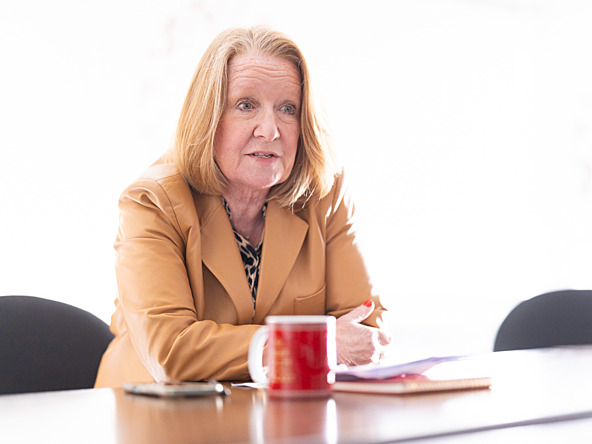
Meeting at the MRS offices in London, Research Live sat down with Mattinson to talk about the value of research and the role it can play in the world of UK politics.
Mattinson has had a long career working in the worlds of both research and politics. Co-founder of Opinion Leader Research in 1992 and later BritainThinks (now Thinks Insight & Strategy) in 2010, Mattinson has also worked for two Labour prime ministers, Gordon Brown and Keir Starmer, including acting as director of strategy for the latter for three years in the lead up to the successful 2024 general election.
Now elevated to the House of Lords as Baroness Mattinson, she says that “if somebody had told me then, ‘fast-forward a lot of years and here you’ll be’, I would have found that very extraordinary”, adding that in the 1980s “I did the MRS diploma course, and that was one of the things that got me going in my career”.
As president at MRS, Mattinson is looking forward to advocating for the wider sector. “It’s a huge honour,” she smiles, “not least because as a young woman working in advertising as an account manager, I could see that knowing stuff, that having information, that having intelligence gave you a bit of power.”

Mattinson adds: “My passion for research stems from the idea that because information is power, if you don’t use it, you don’t have power. What I would like to see is all researchers swimming upstream and thinking much harder about what the research that they’ve collected – however they’ve collected it and however well they’ve collected it – actually means for the organisation that they’re collecting it for. What strategy derives from the research that you’ve garnered? Without that, there’s no point.”
Her appointment comes in MRS’s 80th anniversary year, with past presidents having come from a range of backgrounds, and former Labour prime minister Harold Wilson among past alumni. What does Mattinson think the longevity of MRS shows about the health of the sector? “It obviously shows the resilience and relevance of the industry. It also shows how the industry has managed to evolve again and again. It’s a huge credit to the industry and to MRS that it has continued to have that degree of relevance, and long may it continue. It will, as long as we continue to evolve, change and get ahead of trends.”
Data and democracy
Much has changed in the past 50 years in the world of politics and its use of research, and Mattinson has had first-hand experience of many of those reforms during her time working for Labour politicians. New Labour, under the Blair and Brown governments, while not the first to use insight in politics, saw data having a key role in political decision-making and in the direction of government. Another example from the Conservative governments of the two decades prior is the work of Tim Bell, Margaret Thatcher’s ‘spin doctor’ and political campaigner, who was one of the early pioneers in his use of focus groups and polling data in making strategic decisions and deployment of modern advertising techniques, exemplified by the famous ‘Labour isn’t working’ campaign that helped Thatcher win the 1979 election.
“My passion for research stems from the idea that because information is power, if you don’t use it, you don’t have power.”
The years since have seen even greater encroachment of the principles of data analytics, opinion polling and advertising, with new techniques such as multilevel regression and post-stratification (MRPs), combining polling data with other sources of information, such as censuses, and helping to refine political parties’ use of data.
“People accused politicians [in the 2000s] of being driven by focus groups,” Mattinson recalls. “Which, of course, they’re not, because they’re politicians; they know what they want to do and focus groups just help them to get closer to their audiences and, if you like, to the public.”
Mattinson brings up the example of the 2024 election, where polling data was used to help tailor strategy and provide an accurate picture of the likely outcome. One example was helping to narrow Labour’s focus onto groups of voters which could help it to win the seats needed to take power. “Everybody talked very grandly about Labour’s broad electoral coalition. What that meant was we were basically trying to appeal to pretty much everybody; it was a massive bucket which meant that we were being all things to all people and not really pleasing anybody, and this was very problematic.”

To address the issue, Mattinson, on taking up her new role with Starmer, commissioned segmentation work to understand who the most important voters were, with additional polling and an MRP. The research identified so-called ‘hero voters’ as a key segment – typically working-class people who had felt previously disrespected by Labour. “At the point where I started, we were 12 points behind in the polls, so it made a difference,” she says.
Polling also had an impact on understanding performance in constituencies up and down the country. “In the run-up to the 2024 election, we did our own constituency analysis in the Labour Party and we only got two seats wrong after the event,” Mattinson says. “There were two seats that for a variety of reasons had been particularly tricky and difficult to predict and they were the only two and everything else, we got right.”
The polling industry has come under pressure in recent years for a number of perceived misfires, whereby election results have sometimes differed significantly from what polls were suggesting prior to the event, such as in the case of the 2016 US presidential election, the Brexit referendum of the same year and the 2017 general election, with questions also raised about the industry’s performance in the 2024 general election.
However, Mattinson does not hold the view that there is a problem inherent in polling itself. “I think the problem lies with the people who are reporting it rather than the people who are producing [polls] because I have seen, more times than I could possibly tell you, journalists headlining a change that is not statistically significant,” she says. “They know better than that, and they do it to make a political point, either to say this person’s up or this person’s down. I don’t think that’s to do with the polling, I think it’s to do with the people reporting it and, arguably, there could and should be stricter guidelines around that.”
Polling should never be the sole source of information directing political strategy, adds Mattinson. She champions the role of qualitative research in politics to help get to the heart of voter sentiment. “I think that qualitative, particularly in politics, gives you something you can’t get anywhere else, and it’s so important to understand the language that people use, the body language that they use,” Mattinson says.
“I always made a point, when I was working for Labour, of making sure that every few weeks, we would do a round of focus groups that were face-to-face. Because I think there’s no substitute for really looking into the whites of people’s eyes – really seeing them, and when you ask that question, do they sit back, or do they lean forward? We need to know that and that’s part of your intelligence. If you just take that out, you’re missing something.”
She adds: “A poll will simply give you a snapshot picture and what you need to do is to understand what the emotions are, what the feelings are that are driving that [picture], and that’s when you need the qualitative [research].”

Building connection
Trust in politics is in a difficult place at the moment. Reform and Nigel Farage are riding high in the polls, with similar populist movements on the march elsewhere in the world. Mattinson has studied the so-called ‘red wall’ of post-industrial communities who have felt excluded from wealth accrued elsewhere in the past few decades, publishing the book Beyond the Red Wall in 2020 on the reasons for Labour’s inability to win over voters in those communities.
She argues that across western democracy, people living in similar post-industrial places are “feeling that they are getting a raw deal, often because they are”. She says: “They’re more aware of it now because of the world that we live in. They can go online and go on Instagram and see people living lovely lives and feel a bit cheated. I think they are more hostile towards mainstream government, more mainstream politics than they have ever been.
“Paradoxically, social media and digital media has widened the gap rather than narrowed it, because the algorithm is serving up to people things it thinks they want.”
There are lessons to learn on how to combat populist arguments. Mattinson cites the example of the Australian elections in 2025 as how to make a case for liberal politics, and says one of the biggest successes of prime minister Anthony Albanese’s campaign was to build a connection with voters, adopting the nickname ‘Albo’ and targeting his communications at key voters. Hyper-local politics also played a part, particularly in the health system.
“There’s no substitute for really looking into the whites of people’s eyes – really seeing them. If you just take that out, you’re missing something.”
Data has, over the past two decades, helped usher in greater personalisation to other parts of life, too. “Brilliant companies like Tesco were analysing their Clubcard data and then sending highly personalised messages to people long before we had Instagram or TikTok,” says Mattinson. “So, this isn’t a new thing, but we as an industry need to embrace it and exploit it more than we do. We need to make it work for us. It’s too easy to wring your hands and think you haven’t got a role in this.”
This means embracing new (and old) skills. “You need people who are very good at interpreting the data, seeing the patterns in the data and seeing what the data is telling them, and then you need people who are really good at doing the qualitative, more diagnostic element,” Mattinson explains. “Then you need to be able to pool all that together, but, crucially, what you need more than anything else is to really understand what you’re doing it for. What’s the problem you’re solving here?”
Changes ahead
There has been a long-term challenge for the market research industry to get access to people in positions of power in organisations. “In politics, the people that have the knowledge really matter and will tend to be at the top table,” says Mattinson. “Whether it’s a company that is your client or whether it’s a company you work for, we need to swim upstream and that is about not just collecting the data, but really understanding what the data’s for and then thinking really hard about how you can use it better.”
The same goes for AI. AI has become increasingly central to conversations across the insight industry, even down to whether it poses an existential threat to the future. Mattinson says: “I’m relatively optimistic about AI for the world, not just our industry. But I do think we can’t just sit and let it happen to us. We have to be clear about what we need to do to harness it to be a power for good, both within the market research industry and more broadly. Or it might come back to bite us.”
Many of the skills used in insight are crucial ones in many other walks of life, says Mattinson, adding that market research offers “huge opportunities for different ways of working”. She also feels it is a “very good place for women”, recalling, early in her career, seeing a senior female researcher hold the room as being instrumental in persuading her to work in the industry. “She was a very shy woman, but she would come in, and she would hold the meeting because she knew things that the client needed to know, and I thought, ‘Aha, right’.”
Does she have any final advice for the sector? “Research is only as good as the advice it informs. Only by integrating what we do fully into the overall operation can we succeed.”
Photography by Will Amlot
- Deborah Mattinson will be speaking at the MRS Annual Conference 2026. More details can be found here.

We hope you enjoyed this article.
Research Live is published by MRS.
The Market Research Society (MRS) exists to promote and protect the research sector, showcasing how research delivers impact for businesses and government.
Members of MRS enjoy many benefits including tailoured policy guidance, discounts on training and conferences, and access to member-only content.
For example, there's an archive of winning case studies from over a decade of MRS Awards.
Find out more about the benefits of joining MRS here.










0 Comments